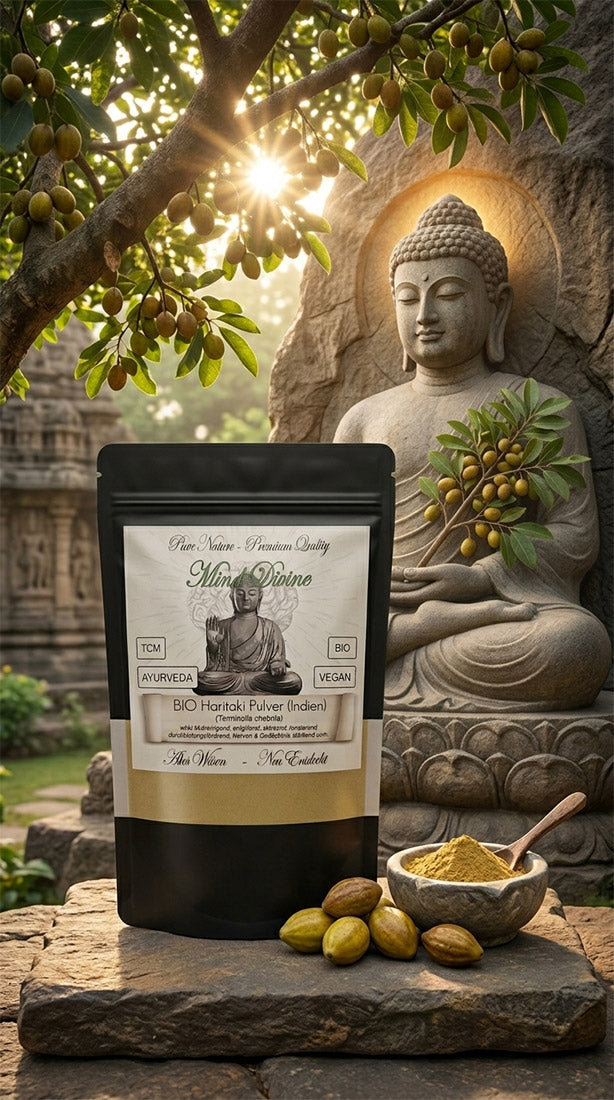
Mind Divine
Organic Haritaki Powder (India)
Organic Haritaki Powder (India)
Couldn't load pickup availability
Origin and Interesting Facts
Haritaki, also known as Harad (Terminalia chebula), has been established in Ayurvedic and Traditional Chinese Medicine for several millennia and is considered a superfood.
In India, this plant is also called the "Queen of Medicinal Plants" due to its incredibly broad spectrum of effects. Even Buddha statues holding a Haritaki branch attest to the cultural and medicinal significance of this plant.
This evergreen tree can be found in the forests of India, China, Sri Lanka, Nepal, and Bangladesh.
Together with the fruits Amalaki and Bibhitaki, Haritaki forms the famous Ayurvedic remedy Triphala, which is primarily attributed with rejuvenating properties.
In Ayurvedic doctrine, there are 6 Rasas (tastes in the mouth):
sweet, sour, salty, pungent, bitter, and astringent – Haritaki covers all these tastes except salty.
Properties and Effects:
In addition to its exceptional blood-purifying effect, Haritaki also has the ability to increase oxygen levels in the blood by up to 300% with regular intake. This improves concentration and memory performance, as well as general physical performance.
The increased oxygen uptake also promotes circulation in the tissues and improves blood flow – thus preventing heart attacks and strokes.
Haritaki strengthens connective tissue – water retention, varicose veins, and high blood pressure can therefore be combated very effectively.
Haritaki helps with skin problems such as pimples and acne, allergic skin reactions, and can also counteract hair loss.
Haritaki is considered a true fountain of youth: it strengthens eyesight, cleanses the gastrointestinal tract, and improves gut flora. It works for both constipation and diarrhea (see applications) and can even remove intestinal parasites.
It strengthens the liver and spleen, as well as nerves and the brain, and can help prevent dementia.
Further properties include:
- laxative (see applications)
- aphrodisiac
- anti-asthmatic
- antibacterial
- antiviral
- eye-strengthening
- expectorant
- blood-purifying
- hemostatic
- bowel-regulating
- circulation-promoting
- detoxifying or cleansing
- anti-inflammatory (bladder and kidney)
- fever-reducing
- diuretic
- skin and tissue-improving
- heart-strengthening
- cough-relieving and mucus-reducing
- nerve and brain-strengthening
- rejuvenating
- wound-healing
- anthelmintic
Nutritional value (per 100g)
Calories 1080 KJ / 263 kcal
Protein 17.8g
Fat 2.9g
of which saturated fatty acids 0.7g
Carbohydrates 2.5g
of which sugar 0g
Dietary fiber 7.1g
Salt <0.1g
Applications:
To detoxify the liver, a 30-day tea cure is recommended.
For this, start with 2g of Haritaki powder, which is steeped in a cup of hot water for about 10 minutes. The powder can be strained or consumed with the tea. If the body tolerates Haritaki well (no nausea or stomach pain), the dose can be increased to 3g after one week.
This can be done in the morning, at noon, or in the afternoon.
For diarrhea, it is recommended to boil 2 - 3g of Haritaki powder in water for 5 - 10 minutes and then drink it sip by sip to firm up loose stools.
For sluggish digestion and constipation, 1 teaspoon of Haritaki powder should be stirred into warm water and drunk.
Warning
Haritaki powder should not be taken during pregnancy!
Note on medical content:
The content presented here provides only an overview of possible medical uses and does not constitute a recommendation for application.
Please always consult a (family) doctor or pharmacist.
Share